Bringing Financial Control to Autonomous AI
Client
Valta
Year
2026
As AI agents become capable of taking autonomous financial actions, teams face a new problem: how do you give software the ability to spend money without giving it unrestricted access to financial systems?
Valta is a financial control layer for autonomous AI agents. It gives every agent its own wallet, spending policies, transaction controls, and immutable audit trail — allowing teams to deploy autonomous systems while maintaining visibility and control over every financial action.
The challenge was to translate this technically complex infrastructure into a SaaS experience that feels trustworthy, understandable, and immediately useful to developers, businesses, finance teams, and enterprise decision-makers.
Scope of Work

Understanding the Problem
AI agents are becoming increasingly autonomous.
They can purchase APIs, interact with vendors, trigger payments, and perform financial actions without a human approving every individual transaction.
Traditional financial infrastructure, however, was designed primarily around human users.
This creates several problems.
Teams may not know:
Which agent is spending money
How much each agent is spending
Where the money is going
Whether a transaction follows company policy
Why a transaction was approved or blocked
What happened after the fact
The problem wasn't simply that teams needed another dashboard.
They needed a control layer between autonomous agents and financial actions.
The website therefore had to communicate a complex infrastructure product in a way that immediately established one central idea:
AI can act autonomously without operating blindly.

Design Approach
I structured the experience around three core principles:
01 — Make the Invisible Visible
Agent spending happens in the background.
The landing page therefore needed to visualize the activity that normally remains hidden — transactions, policies, balances, approvals, blocked actions, and audit events.
02 — Lead With Control
Instead of positioning Valta purely as a payments product, the experience emphasizes governance.
The core story becomes:
Identity → Policy → Enforcement → Audit
This makes the product's value immediately understandable.
03 — Design for Multiple Audiences
Valta serves developers building autonomous systems, businesses deploying AI agents, and enterprise teams responsible for finance and compliance.
The experience therefore provides different entry points while maintaining one consistent product narrative.

Key Design Decisions
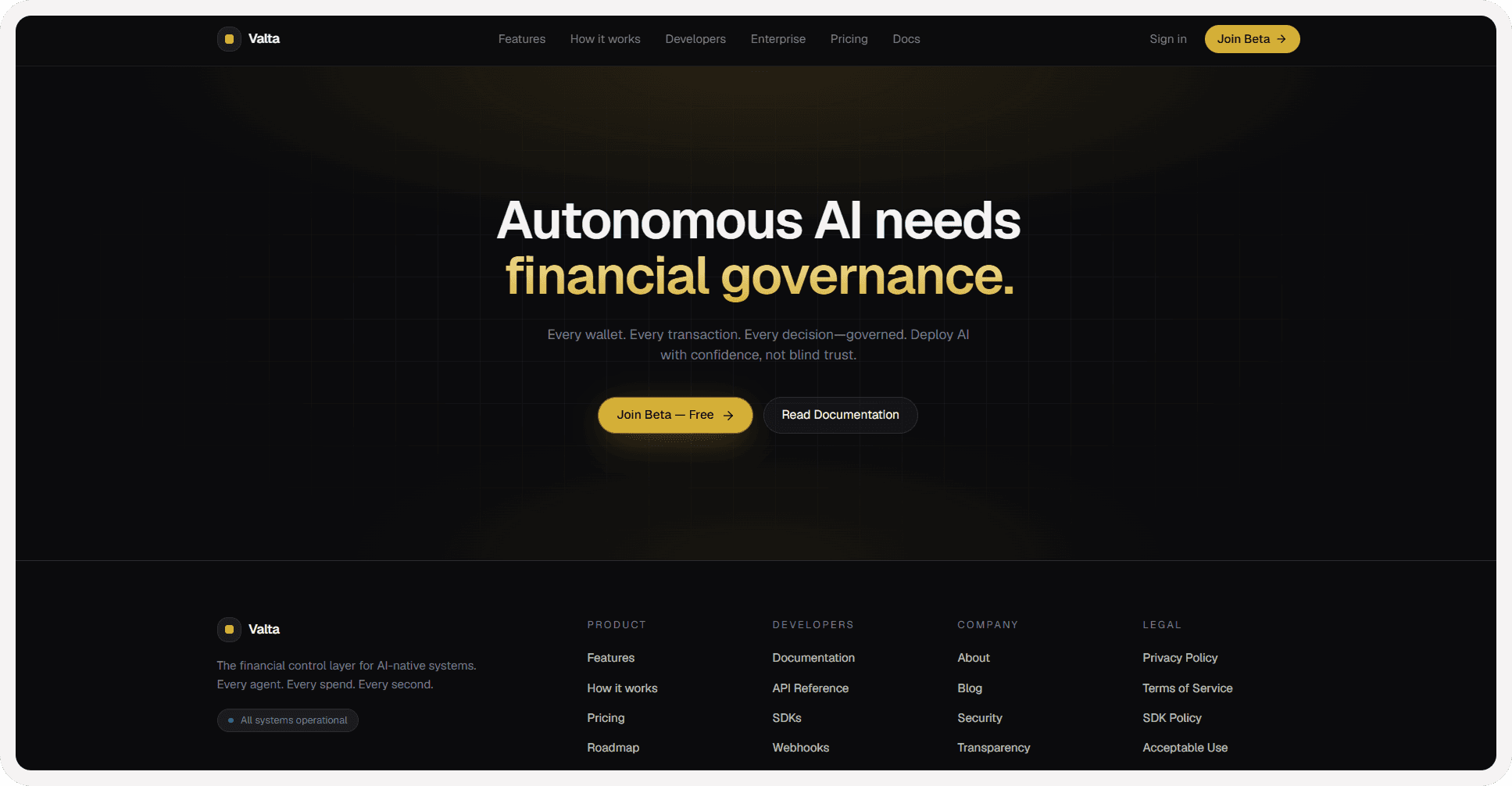
A Hero That Explains the Category
The hero immediately establishes the product category:
The financial control layer for autonomous AI agents.
Rather than relying on generic AI messaging, the supporting copy explains the actual primitives Valta provides:
Wallets. Spending policies. Immutable audit trails.
This gives visitors a concrete understanding of the product from the first interaction.
Showing the Control Plane
One of the most important design decisions was to show the Valta dashboard directly within the marketing experience.
Instead of telling users that Valta provides visibility, the interface demonstrates it.
The dashboard surfaces:
Active agents
Wallet balances
Blocked transactions
Recent activity
Spending policies
Approval thresholds
Allowed merchants
Audit information
Emergency controls
This turns an abstract infrastructure product into something tangible.


From Agent Action to Controlled Transaction
Valta's core workflow was simplified into a four-stage system:
AI Agent
Autonomous action
↓
Valta Policy Engine
Evaluate and log
↓
Wallet
Debit / hold
↓
Payment
Executed
This visualization communicates the product's role without requiring visitors to understand the underlying infrastructure first.
The key idea is clear:
Valta sits between the agent and the money.
Making Risk Understandable
The website frames autonomous spending around the risks teams already understand.
No Visibility
Spending can happen across multiple agents, vendors, and credentials.
No Limits
A faulty or compromised agent could potentially spend beyond its intended budget.
No Audit Trail
Finance and compliance teams may struggle to reconstruct what happened after transactions occur.
Instead of using fear-based messaging, the redesign introduces a direct solution to each problem.
Dedicated wallets.
Enforced spending policies.
Real-time monitoring.
Immutable audit history.
Instant kill switch.
This creates a clear problem → solution relationship throughout the page.

The Product Experience
The product section positions Valta as a unified control plane for autonomous financial activity.
From one dashboard, teams can:
Monitor agent balances
Review transactions
Define spending policies
Approve or block activity
Freeze agents
Monitor alerts
Export audit records
The interface is designed around the idea that financial governance should happen continuously rather than after the fact.
Designing the Six Core Primitives
Valta's product is built around six fundamental capabilities.
One Wallet Per Agent
Each agent receives an isolated financial identity and transaction history.
Spending Policies
Teams can define daily limits, transaction caps, merchant restrictions, and approval thresholds.
Runtime Interception
Transactions are evaluated before they reach the payment layer.
Instant Kill Switch
Agents can be frozen immediately when something goes wrong.
Immutable Audit Trail
Every financial action can be traced through timestamp, identity, amount, destination, policy, and status.
Governance Signals
Alerts, webhooks, and anomaly detection provide visibility while agents are still operating.
Rather than presenting these as disconnected features, the design treats them as parts of one governance system.

Showing the Difference
A major part of the landing page communicates the value of Valta through a direct comparison.
Without Valta
Unlimited spending
Shared credentials
Manual reconciliation
No audit trail
Reactive monitoring
No kill switch
With Valta
Dedicated wallet per agent
Enforced spending policies
Real-time visibility
Immutable audit history
Instant alerts and approvals
One-click kill switch
This makes the product's value proposition immediately scannable without requiring visitors to understand every technical detail.
Designing for Developers
Valta isn't only a business product.
Developers need to understand how quickly they can integrate it into their existing AI systems.
The developer section therefore shifts from product marketing to implementation.
The page introduces:
TypeScript SDK
REST + Python
Webhooks
Runtime enforcement
and provides a practical code example showing how an agent can be created, funded, governed, and monitored.
This gives technical buyers enough context to understand that Valta is infrastructure they can actually build with — not simply another financial dashboard.
Designing for Different Buyers
The website provides distinct value propositions for three audiences.
Developers
Build AI agents without having to build the financial infrastructure around them.
Businesses
Control and monitor AI systems from one centralized environment.
Enterprise
Introduce governance, approvals, role-based access, and compliance-ready reporting into autonomous AI operations.
This allows the same product to speak to different decision-makers without fragmenting the overall positioning.
Solution / Product Experience
The final experience follows a deliberate narrative:
Problem → Control Layer → Product → Capabilities → Workflow → Comparison → Developer Integration → Use Cases → Enterprise Governance
Visitors first understand why autonomous financial activity creates a new problem.
They then learn where Valta fits.
The product dashboard makes the solution tangible.
The feature architecture explains how control is achieved.
The workflow demonstrates how it operates.
The comparison reinforces the value.
Finally, developer and enterprise sections address the practical requirements of adoption.
The result is a landing page that behaves more like a product experience than a traditional marketing website.
Outcome
The redesigned experience gives Valta a clear way to communicate a technically complex category: financial governance for autonomous AI.
Instead of leading with abstract AI terminology, the website grounds the product in tangible concepts that buyers can immediately understand:
Wallets.
Policies.
Transactions.
Audit trails.
Control.
The product feels less like an invisible infrastructure layer and more like a tangible operating system for managing autonomous financial activity.
Business Impact
Clearer Category Definition
The website immediately communicates what Valta is and where it sits within the AI and financial infrastructure ecosystem.
Stronger Trust
Financial products require a high level of confidence. The dashboard, policy controls, audit trails, and emergency controls make that trust visible through the product itself.
Better Product Understanding
Complex infrastructure is broken down into understandable primitives and workflows.
Stronger Developer Appeal
The dedicated developer experience demonstrates how Valta can integrate directly into AI agent infrastructure.
Enterprise Readiness
Governance, approval workflows, role-based access, auditability, and reporting position the product for organizations that require stronger financial controls.
Conversion-Focused Storytelling
Every section moves the visitor closer to understanding why autonomous systems need financial governance and why Valta is built to provide it.
The Design Principle
Autonomous doesn't have to mean uncontrolled.
The experience was designed around a simple idea:
Give AI agents the freedom to act — while giving the humans responsible for them the visibility and control to know exactly what they're doing.