Turning Legal Tech Complexity Into Clarity
Client
Aegis
Year
2026
A modern legal technology consultancy needs to communicate two things at once: deep technical expertise and the confidence required to advise highly regulated, risk-sensitive organizations.
The challenge was to create a digital experience that positioned the firm as more than another technology consultancy. The website needed to clearly communicate its expertise across legal operations, automation, AI, systems integration, cybersecurity, and change management while making the value of each service immediately understandable to potential clients.
The result is a premium, technology-forward website designed to build authority, simplify a complex service offering, and turn expertise into meaningful conversations with law firms, corporate legal teams, and enterprise decision-makers.
Scope of Work


Understanding the Problem
Legal technology is a complex category.
A consultancy may work across contract lifecycle management, workflow automation, AI integration, data security, technology implementation, and legal operations. Presenting all of these capabilities on one website can quickly create an overwhelming experience.
The challenge was therefore not simply to "make the website look premium."
It was to answer three questions quickly:
What does the firm do?
Who does it help?
Why should a legal or enterprise team trust them with complex technology transformation?
The existing complexity of the industry also created another challenge. Legal buyers are typically risk-conscious and need confidence before engaging a consultancy.
The website therefore needed to communicate expertise without becoming overly technical, while establishing trust without relying on walls of corporate copy.

Design Approach
I built the experience around three core principles:
01 — Make Complexity Understandable
The firm's capabilities were organized into clear service categories rather than presented as a long list of technical offerings.
02 — Lead With Authority
Every major section was designed to reinforce expertise, credibility, and precision — characteristics that matter when selling technology transformation to legal organizations.
03 — Turn Expertise Into Action
The website was structured around the questions potential clients are likely to have, gradually moving them from understanding the firm's capabilities to exploring its work and ultimately starting a conversation.
The result is a website that feels less like a traditional consulting brochure and more like a modern technology platform.


A Clear Service Architecture
The consultancy operates across several complex areas, including:
Technology strategy
Workflow automation
Contract lifecycle management
Legal AI
Systems integration
Cybersecurity
Regulatory compliance
Change management
Rather than presenting these capabilities as one overwhelming list, they were organized into a structured service system.
Each service communicates:
What it is → What problem it solves → Why it matters
This allows visitors to quickly identify the capability relevant to their organization.
Designing for Different Buyers
The website serves multiple audiences, from law firms to corporate legal departments and legal technology vendors.
Instead of forcing every visitor through the same journey, the information architecture introduces solutions around client needs.
This creates a more relevant path for users who may be approaching the consultancy from completely different perspectives.
A law firm looking to modernize its operations can find its relevant solutions quickly, while an enterprise legal department can focus on areas such as contract management, automation, analytics, and integration.

Building Trust Above the Fold
For a legal technology consultancy, credibility cannot be an afterthought.
The hero experience was therefore designed to communicate positioning immediately while introducing trust signals early in the journey.
The visual direction combines:
Precision + Technology + Authority
with a restrained, premium interface rather than the overly corporate aesthetic common across professional services websites.
The objective was to make the firm feel technologically advanced without sacrificing the trust expected from the legal industry.
The Solution
Strategy Before Software
The website introduces the consultancy as a strategic partner rather than simply an implementation provider.
Its capabilities span the transformation journey:
Audit → Strategy → Implementation → Integration → Adoption
This helps potential clients understand that the firm can support them beyond simply recommending another software platform.
Interactive Service Experience
The service section uses a more interactive presentation to make a complex offering easier to explore.
Instead of forcing visitors to read long descriptions, services are presented as focused modules that can reveal additional information when explored.
This creates a more engaging experience while keeping the initial interface visually clean.
Solutions Built Around Real Problems
The experience shifts the conversation away from technology for technology's sake.
Instead of simply saying:
"AI Integration"
the experience connects technology to practical outcomes such as:
Automating contract review
Improving legal research
Reducing manual workflows
Connecting disconnected systems
Improving operational visibility
This makes the firm's expertise easier for non-technical decision-makers to understand.

Designing for Conversion
The website was structured around a progressive trust journey:
Understand → Explore → Validate → Engage
Visitors first understand what the consultancy does.
They then explore relevant services and solutions.
Case studies, credentials, technology partnerships, and expertise provide validation.
Finally, strategically placed calls to action invite high-intent visitors to begin a conversation.
Rather than aggressively pushing a sales message throughout the site, conversion points appear naturally once enough context and trust have been established.
Thought Leadership as a Trust Engine
For a specialist consultancy operating in a rapidly changing field, the website cannot rely entirely on service pages to establish authority.
An Insights and Resources experience was therefore positioned as part of the firm's broader credibility system.
Content around topics such as legal AI, workflow automation, contract management, and legal technology transformation allows the consultancy to demonstrate expertise before a prospect ever speaks with the team.
This transforms the website from a static company brochure into an ongoing authority-building platform.
Outcome
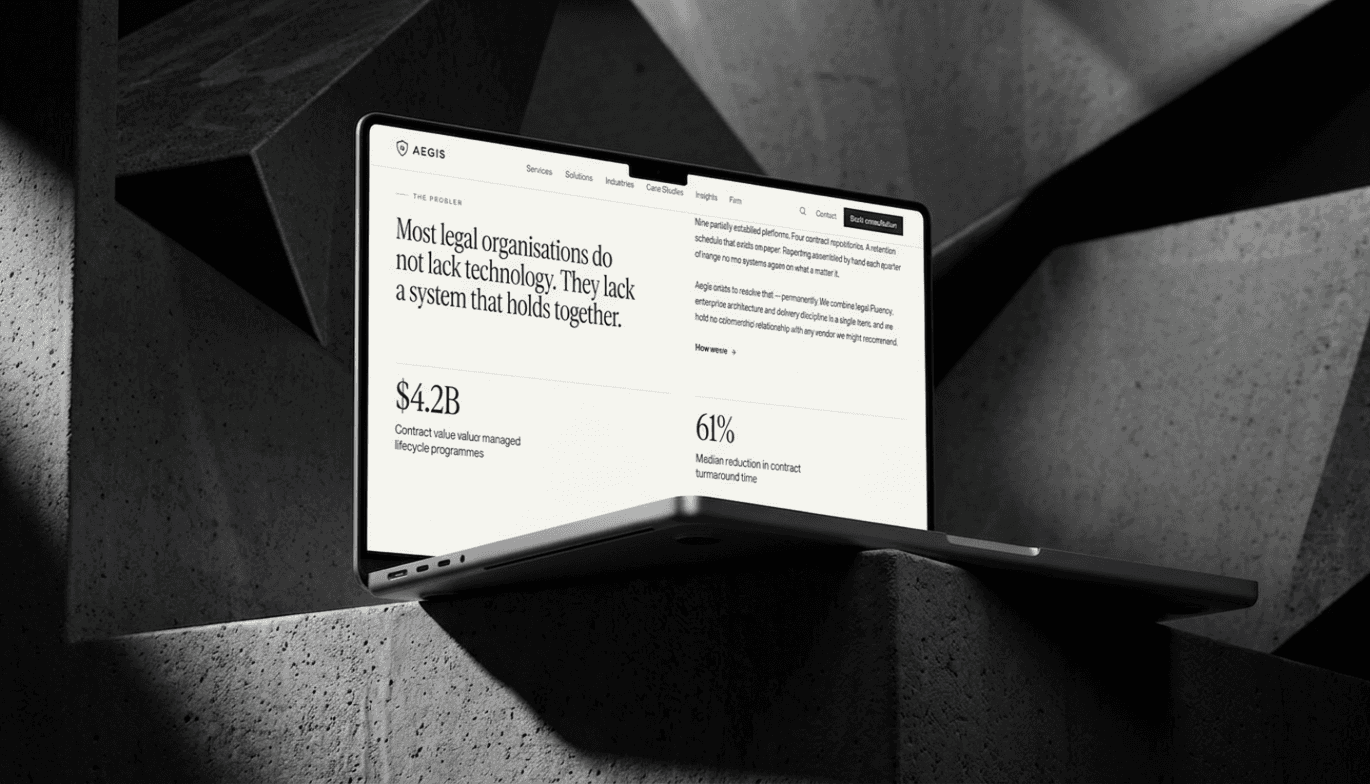
The redesigned website creates a clearer and more compelling digital presence for a specialist legal technology consultancy.
Complex capabilities are organized into an understandable service architecture, different client audiences can identify relevant solutions more easily, and the visual system creates a balance between technological sophistication and professional credibility.
Most importantly, the website communicates a stronger positioning:
The consultancy isn't simply helping legal teams buy technology. It helps them understand, implement, integrate, and successfully adopt it.

Business Impact
Stronger Market Positioning
The website presents the consultancy as a strategic technology partner rather than a traditional IT services provider.
Faster Understanding
Visitors can quickly understand the firm's services, target clients, and areas of expertise without navigating dense technical content.
Increased Trust
Credentials, case studies, technology partnerships, security considerations, and thought leadership are integrated into the experience to support high-consideration buying decisions.
Better Conversion Journey
The information architecture guides prospects from initial awareness through exploration and validation toward consultation.
Scalable Digital Foundation
The modular structure provides room for future case studies, insights, service offerings, technology partnerships, and industry-specific solutions without requiring the website to be rebuilt.
The Design Principle
When the service is complex, the experience shouldn't be.
The goal was never to remove the sophistication of legal technology.
It was to make that sophistication easier to understand, easier to trust, and easier to act on.